

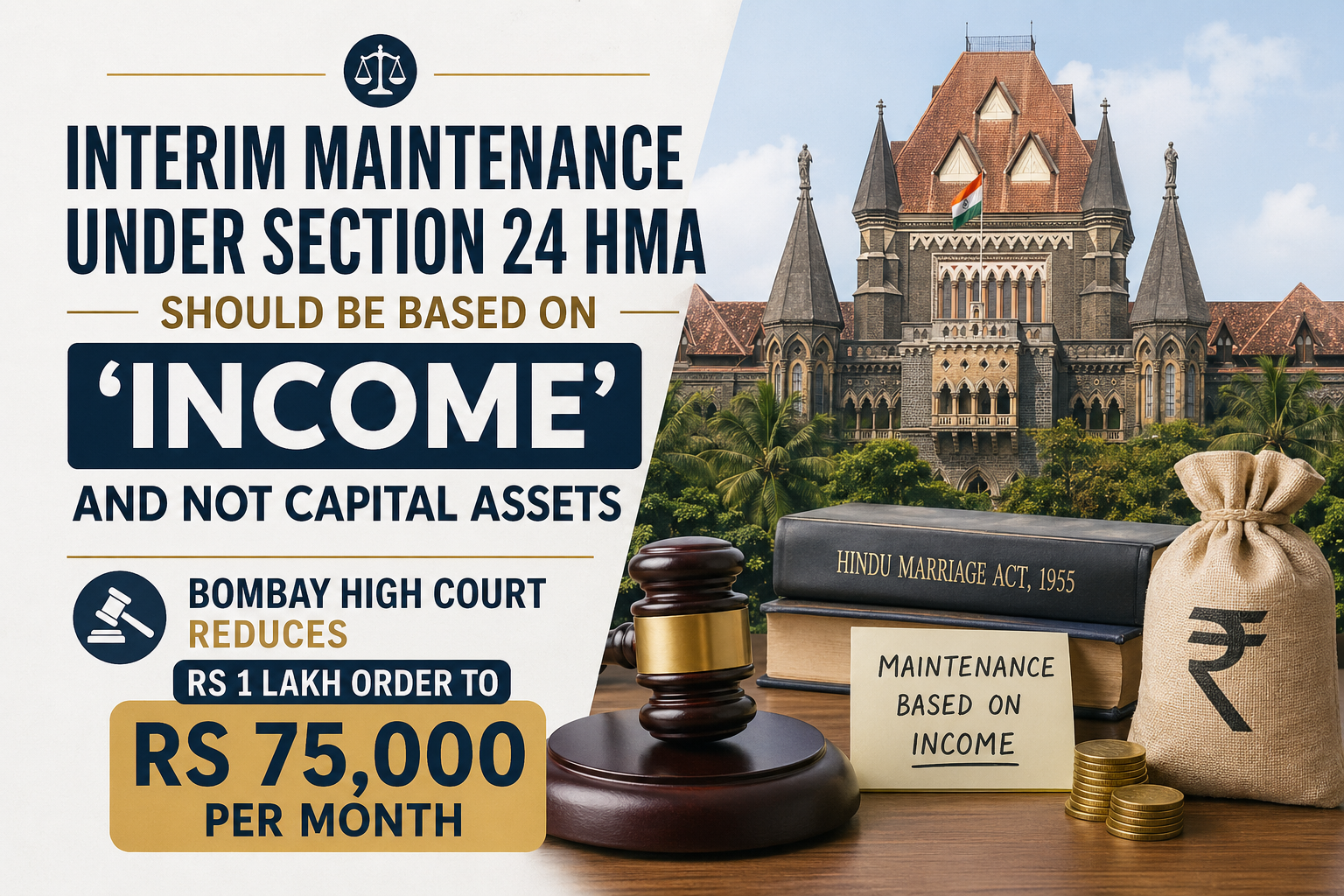
“Why am I being asked to pay so much maintenance when I don’t even earn that much?”
This is something I hear very often in my office. A client walks in, upset, holding a court order for interim maintenance, and says, “Sir/Ma’am, they’ve calculated everything I own… not what I actually earn.”
A recent decision by the Bombay High Court (Nagpur Bench) gives some much-needed clarity on this exact issue.
Interim Maintenance Under Section 24 HMA – What Really Matters?
Under Section 24 of the Hindu Marriage Act, a spouse can ask for interim maintenance (pendente lite) during the case. This is meant to support day-to-day expenses while the case is ongoing.
Now here’s the key point:
The Court said Only “income” should be considered — not property or capital assets.
So if someone owns property, shares, or assets that don’t generate income, those should not be used to inflate maintenance.
Background of the case
The petitioner (husband) and respondent (wife) were married on November 27, 2004. In March 2019, the husband alleged that he had discovered his wife’s extramarital affair, after which they separated. Subsequently, the husband filed a petition for divorce under Section 13(1)(i) and (ia) of the HMA, while the wife filed a petition for restitution of conjugal rights under Section 9.
During the divorce proceedings, the wife applied for interim maintenance of ₹500,000 per month under Section 24. On March 13, 2023, Family Court No. 3, Nagpur, directed the husband to pay interim maintenance of ₹100,000 per month and litigation costs of ₹25,000. The husband challenged this order in the High Court.
Arguments of the parties
Petitioner (Husband):
Appearing for the husband, Mr. Rishi Bhargava argued that the Family Court overlooked the mandatory financial disclosure norms laid down by the Supreme Court in Rajneesh v. Neha. He contended that the Court wrongly applied the principles governing permanent alimony under Section 25 to a case concerning interim maintenance under Section 24.
He further submitted that the husband’s annual income is around ₹20 lakh and highlighted that he is already bearing the full cost of his children’s education in the United Kingdom. Additionally, he alleged that the wife is independently earning about ₹20,000 per month through a catering business operating under the name “Narmada Caterers.”
Respondent (Wife):
On the other hand, counsel for the wife, Mr. Ritesh Badhe, argued that she is entitled to maintain a lifestyle consistent with that of her husband, who frequently travels abroad and holds investments in multiple companies. He denied the claim that the wife runs any catering business, clarifying that “Narmada Caterers” is owned by her brother. He also pointed out that the husband’s ability to invest in high-value property in a separate civil matter reflects his strong financial capacity.
What Did the Court Decide?
In Sachin vs. Harshada Agne, the Court reduced interim maintenance from ₹1,00,000 to ₹75,000 per month.
The Court made two important observations:
1. Income vs Property – Clear Difference
- Section 24 HMA → looks at income only
- Section 25 HMA → considers income + property
The Court used a simple analogy:
“The fruits of the tree are income, not the tree.”
Meaning:
- Rental income = considered
- Salary = considered
- Business profit = considered
- But land, shares, or idle assets = not directly counted
2. But Courts Will Look Beyond What You Show
In practice, courts don’t just blindly accept income tax returns.
In this case:
- Husband showed income of around ₹20 lakh annually
- But he had major stakes in companies
The Court observed that even if income is not directly shown, financial capacity can still be assessed.
A Real-Life Example (Very Common)
Let’s say:
- Husband earns ₹1.5 lakh/month salary
- He owns 2 flats but they are not rented out
- Wife claims ₹2 lakh/month maintenance citing property ownership
In such a situation:
The Court will primarily look at the ₹1.5 lakh income, not the value of flats.
However, if it appears that assets are being deliberately kept idle to avoid liability, the Court may take a broader view.
What Many Clients Assume (But It’s Not Always True)
- “If I show low income, I’ll pay less maintenance”
- “If I have property, I’m automatically liable for high maintenance”
Both are only half-truths.
Courts look at:
- Lifestyle
- Spending patterns
- Hidden income sources
- Business control
Common Mistakes People Make
1. Hiding or Underreporting Income
Courts often go beyond income tax returns.
2. Confusing Section 24 with Section 25
Interim maintenance is temporary, not final alimony.
3. Not Filing Proper Financial Disclosure
After the Supreme Court judgment in Rajnesh v. Neha, detailed affidavits are required.
4. Making Unrealistic Claims
Claiming very high expenses without proof rarely works.
5. Ignoring Children’s Expenses
Education and other responsibilities are always considered.
What You Should Do
- Be honest about your income
- Prepare a proper monthly expense sheet
- Clearly show liabilities like loans and education costs
- Understand this is interim, not final maintenance
- Take proper legal advice early in the case
FAQs
1. Can property be considered for interim maintenance?
Not directly. Courts primarily consider income under Section 24.
2. What if the husband has assets but no income?
The Court may still assess overall financial capacity and earning potential.
3. Is interim maintenance final?
No. It is temporary and subject to final decision under Section 25.
4. Can interim maintenance be reduced later?
Yes, if circumstances change or the original order is excessive.
5. Do courts consider lifestyle?
Yes, courts try to maintain a reasonable standard of living.
Final Thoughts
In real cases, maintenance is rarely just about numbers on paper. It’s about fairness during the case.
This judgment makes one thing clear: you pay based on what you earn, not just what you own.
At the same time, courts can look deeper if they feel income is being hidden. The way you present your financial details at this stage often shapes the entire case.


Leave a Reply