Let’s say you help your son in a financial deal. Money is taken, things go wrong, and later a cheque is issued from his account. The cheque bounces. A case is filed. And suddenly, you also receive court summons.
A lot of people assume this is normal.
But legally, it’s not that simple.
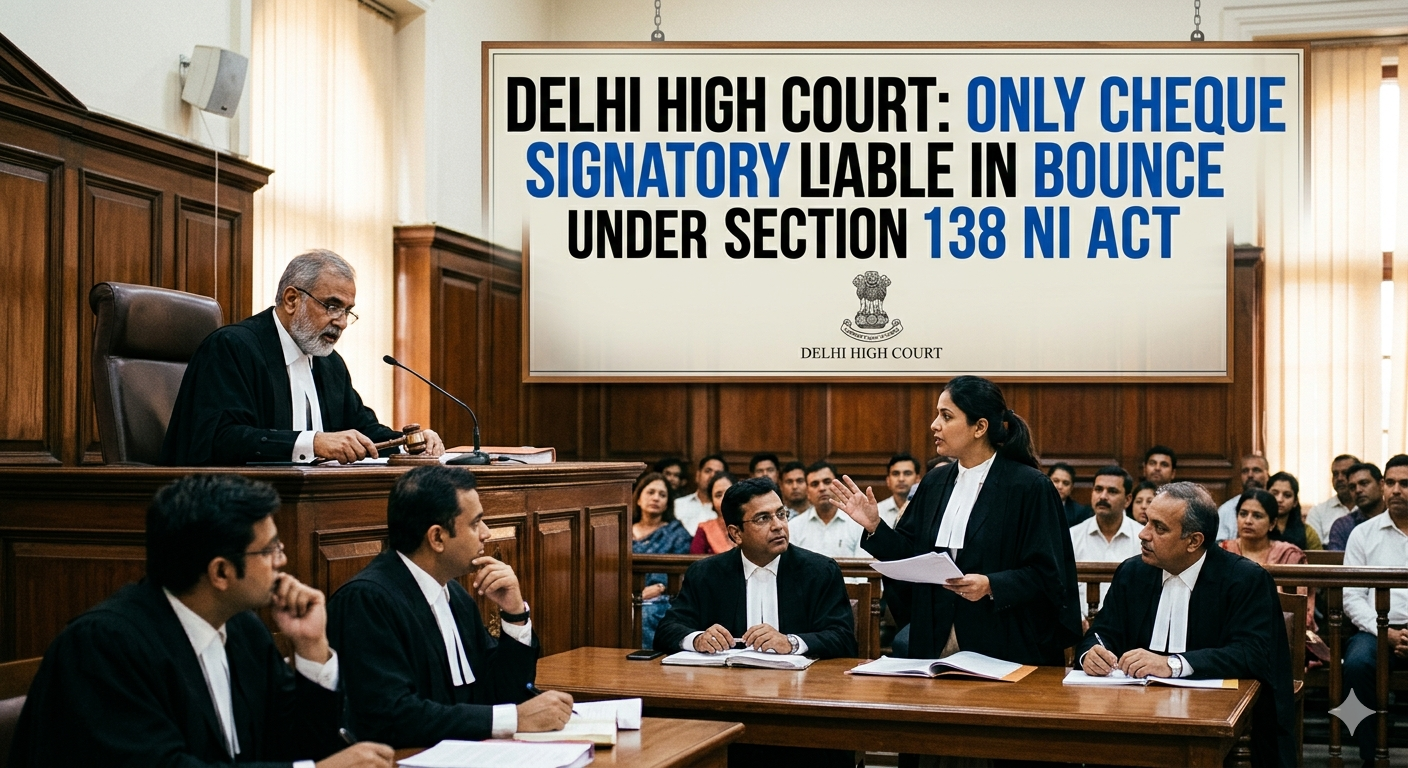
A recent ruling by the Delhi High Court makes this very clear.
What Happened in This Case
In Sudha Devi vs Anil Kumar, the dispute started with a property deal. The complainant claimed he paid around ₹10 lakh to Sudha Devi and her son.
The deal didn’t go through. To return the money, the son issued a cheque. That cheque bounced due to insufficient funds.
A cheque bounce case in India was filed under Section 138 of the NI Act. The trial court summoned both the son and the mother.
But here’s the key point:
The mother had not signed the cheque.
The Real Legal Question
Can someone who did not sign the cheque be prosecuted in a cheque bounce case?
In practice, we often see complainants include multiple family members just to increase pressure. Many clients assume that if there is a “joint deal,” then everyone becomes criminally liable.
That assumption is not correct under cheque dishonour law in India.
What the Court Clarified
Justice Saurabh Banerjee clearly held that:
Criminal liability under Section 138 NI Act is limited only to the “drawer” of the cheque.
In simple terms, the drawer is the person who:
- Signed the cheque
- Holds the bank account from which the cheque is issued
The Court looked at the facts and found:
- The cheque was issued by the son
- The bank account was not in the mother’s name
- She had no role in issuing the cheque
So, continuing criminal proceedings against her made no legal sense.
Key Legal Principle You Should Understand
The Court relied on the Supreme Court judgment in Alka Khandu Awhad v. Amar Shyam Prasad Mishra.
Even if there is a joint liability, only the person who actually signs the cheque can be prosecuted under Section 138 NI Act.
There is no automatic joint criminal liability in cheque bounce cases involving individuals.
A Practical Example
Let me explain this the way it usually happens in real life.
A father and son borrow money together. Later, the son issues a cheque from his account. The cheque bounces.
Now legally:
- The son can face a cheque bounce case
- The father cannot be prosecuted under Section 138, unless he also signed the cheque
Common Mistakes People Make
1. Naming Everyone in the Complaint
Many complainants include family members assuming “more names = more pressure.” Courts don’t support this approach.
2. Ignoring Who Signed the Cheque
The entire case under Section 138 revolves around the cheque. If someone hasn’t signed it, their liability is very limited.
3. Treating Civil Liability as Criminal Liability
Just because someone owes money doesn’t mean they can be prosecuted criminally.
4. Not Challenging Wrong Summons
People often accept summons without questioning whether the case is legally valid against them.
What You Should Do
If You Are a Complainant:
- File the case only against the actual cheque signatory
- Ensure the cheque and bank details clearly support your claim
- Avoid adding unnecessary parties
If You Have Been Wrongly Summoned:
- Check if you signed the cheque or own the account
- If not, you can challenge the case in the High Court
- File a petition under Section 482 CrPC to quash proceedings
Final Thought
In a cheque bounce case, liability follows the signature, not the relationship or the transaction.
If you are dealing with a cheque bounce case in Delhi, take timely legal advice. These issues can be resolved, but only if handled properly from the beginning.
Frequently Asked Questions
1. Can a non-signatory be held liable in a cheque bounce case in India?
No. Only the cheque signatory (drawer) is criminally liable under Section 138 NI Act.
2. What if the loan was taken jointly?
Criminal liability applies only to the person who issued the cheque. Others may have civil liability.
3. Can a family member be included in a cheque bounce case?
Only if they signed the cheque. Otherwise, it can be challenged.
4. What should I do if I receive summons wrongly?
Consult a lawyer and file a quashing petition before the High Court.
5. Does this apply to all cheque bounce cases in Delhi?
Yes, this principle generally applies across India.

Leave a Reply