
Cheques still run Indian business. Old school, yes. Reliable, mostly. And when one gets returned with a “signature mismatch” remark, the first reaction is predictable: Great, Section 138 won’t apply.
But that confidence is often misplaced.
So let’s get this straight. Does a handwriting or signature issue automatically wipe out liability under Section 138 of the Negotiable Instruments Act, 1881?
Short answer: no.
Longer answer: it depends on what actually caused the dishonour.
Here’s where courts have drawn the line.
Signature mismatch isn’t the end of the story
Banks return cheques for all kinds of reasons. Signature differs. Incomplete signature. Payment stopped. Funds insufficient.
But a bank memo doesn’t decide criminal liability. Courts do.
Judges have said this again and again: a simple difference in signature does not, by itself, kill a Section 138 case. The real question is more uncomfortable for the drawer. Was the cheque genuine? Was there a real debt? And why did the cheque bounce in the first place?
In Suresh Singh Sikarwar vs Radheshyam Sharma (2024), the court made it clear that if the signature is actually forged, then yes, Section 138 won’t apply. A forged instrument isn’t a cheque in the eyes of law.
But.
And this matters.
The court also said judges can’t blindly accept the bank’s remark. If the bank says “signature differs,” the court still has to dig deeper. Was it really a forgery, or just a variation? Was the dishonour actually because of insufficient funds?
That distinction changes everything.
So when does Section 138 still apply?
More often than people expect.
If the cheque came from the drawer’s account, and the signature is admitted or later proved to be genuine, the law steps in with a presumption. Section 139 assumes the cheque was issued for a legally enforceable debt. The burden then shifts to the accused.
In Frontline NCR Business Solution Pvt. Ltd. vs Redington (India) Ltd. (2023), the court held that once issuance and signature are not convincingly disputed, the presumption works in favour of the complainant. Even a stop-payment instruction didn’t rescue the drawer there.
And yes, even where signature questions are raised, courts have leaned toward liability unless forgery is clearly established.
One Kerala High Court ruling went a step further. It said that if there’s doubt because the signature doesn’t match other documents, the right approach is expert examination, not dismissal of the case.
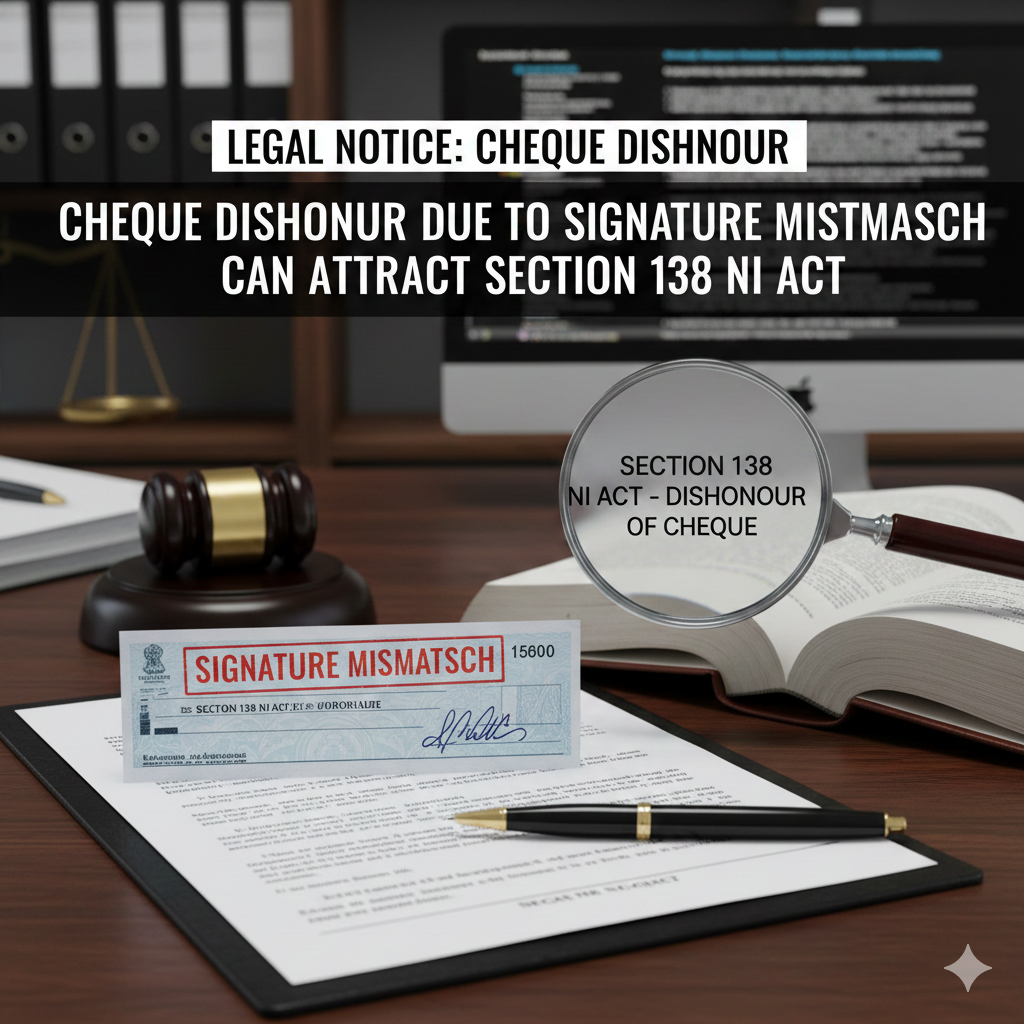
Another court put it bluntly: dishonour due to signature mismatch can still attract Section 138.
Uncomfortable? Maybe. Settled law? Largely, yes.
What really matters to the court
Courts don’t obsess over handwriting styles. They focus on intent and evidence.
They ask:
- Was the cheque issued to discharge a debt or liability?
- Was it presented on time?
- Did it bounce for a reason covered under the Act?
- Was legal notice sent within 30 days?
- Did the drawer fail to pay within 15 days?
Tick these boxes, and the case stands.
If the defence wants out on the ground of signature mismatch, they can’t just point at the bank memo and relax. They have to prove forgery. Usually through handwriting experts or solid circumstantial evidence. Without that, the presumption under Sections 118 and 139 stays intact.
And yes, this applies even to security cheques. Even to blank cheques that were signed and later filled in. Courts have been very clear on this.
When Section 138 genuinely won’t apply
There are limits.
If expert evidence shows the signature is forged, the cheque collapses.
If the cheque was never issued for a lawful debt, say a lost or misused cheque, liability can fail.
And if the only reason for dishonour is a confirmed forgery, Section 138 doesn’t get triggered at all.
In those cases, the instrument itself falls outside the definition of a cheque under the Act.
Practical advice, minus the fluff
If you’re the complainant, don’t panic over a “signature differs” return memo. Collect specimen signatures. Preserve transaction records. Lean on the statutory presumption.
If you’re the accused, act fast. If forgery is your defence, prove it. Courts won’t do that work for you.
And for judges, the reminder remains the same: don’t treat bank endorsements as gospel. Find the real reason behind the dishonour.
So here’s the bottom line.
- A signature mismatch doesn’t magically erase Section 138.
- Forgery has to be proved.
- Presumptions favour the payee.
- And courts look past bank remarks to the substance of the transaction.
That’s the law as it stands.
Annoying for some. Reassuring for others. But fairly consistent now.
This is a general discussion based on recent judicial trends. For advice on a specific case, talk to a lawyer who can look at your facts closely.
Frequently Asked Questions (FAQs)
- Does a cheque bounce due to signature mismatch attract Section 138 NI Act?
Yes, it can. A signature mismatch by itself does not cancel liability under Section 138. Courts look at the real reason for dishonour and whether the cheque was issued for a valid debt.
- Is signature mismatch a valid defence in a cheque bounce case?
Only if the drawer proves that the signature is forged. A mere bank remark saying “signature differs” is not enough.
- Can a bank’s endorsement of “signature differs” end the case?
No. Courts are not bound by the bank’s memo. The judge must independently examine whether the cheque was genuine and why it was dishonoured.
- What if the signature is slightly different from the specimen?
Minor variations do not help the accused. Handwriting naturally varies. Unless forgery is proved through evidence, Section 138 can still apply.
- Who has the burden of proof when signature mismatch is alleged?
Once issuance of the cheque is shown, the burden shifts to the accused to disprove liability, usually by expert handwriting evidence.
- Can a forged signature cheque attract Section 138 NI Act?
No. If the signature is conclusively proved to be forged, the cheque is not legally valid and Section 138 will not apply.
- Does Section 139 presumption apply in signature mismatch cases?
Yes. Courts presume the cheque was issued for a legally enforceable debt unless the accused successfully rebuts that presumption.
- Can a security cheque bounced due to signature mismatch lead to prosecution?
Yes. Even security cheques can attract Section 138 if the signature is genuine and the cheque was issued towards a liability.
- What evidence is needed to prove a forged signature?
Handwriting expert opinion, comparison with admitted signatures, and surrounding circumstances are commonly relied upon.
- Should the complainant re-present a cheque returned for signature mismatch?
If legally permissible and advised by counsel, re-presentation can strengthen the case, especially when funds are available and the drawer avoids liability tactics.

Leave a Reply